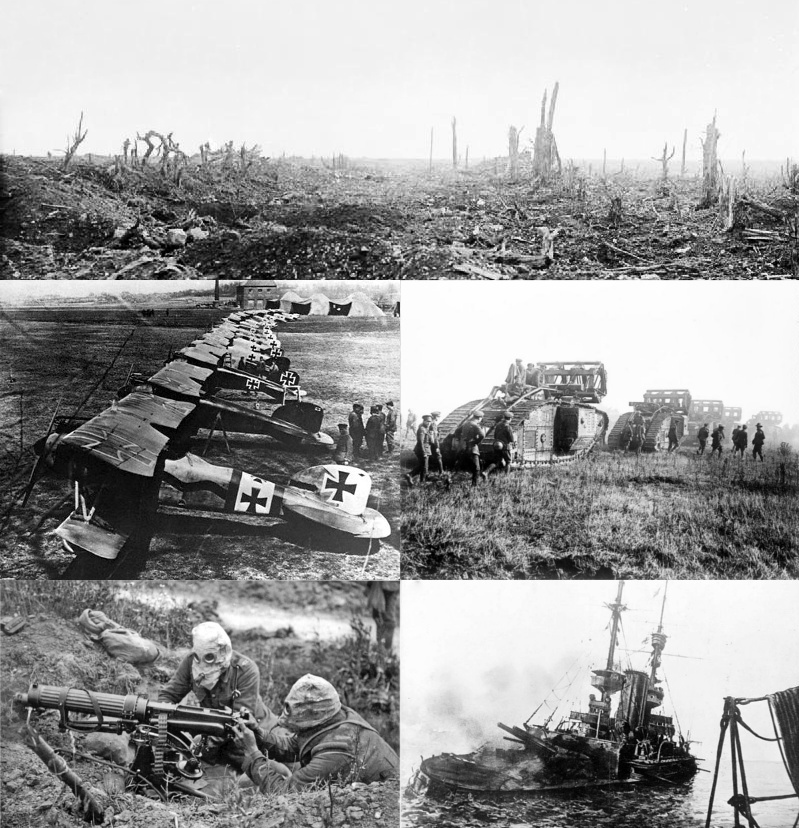
War World 1, belligerents are the Allied (Entente) Powers and the Central Powers, which was centered in Europe lasting about four years from July 28, 1914 till November 11, 1918. In this war more than 9 million combatants, people who are directly involved in the war, died. The war brought in economic world powers where the Triple Entente was based on United Kingdom, France, and Russian Empire and the Central Powers based on Germany and Austria-Hungary. War World I was the introduction to warfare and the use of modern technology which resulted in mass destruction and death, and by November 1918 more than 9 million soldiers were killed.
Chemical weapons in warfare, such as poison gas was introduced by Imperial Germany in 1915 the Battle of Bolimov. Through chemical weapons used by both sides it was estimated of a 1.3 million casualties. Chemical casualties- for British was over 180,000 during war, one-third of U.S. casualties by gas, and 500,000 chemical weapon casualties reported by Russian Army. The 1899 Hague Declaration Concerning Asphyxiating Gases and the 1907 Hague Convention on Land Warfare were treaties prohibiting the use of chemical warfare which both sides violated. Soldiers were not the only endangered from the chemical warfare, civilians were also endangered due to blowing winds and ineffective gas masks. The idea of genocide and ethnic cleansing was prevalent in War World I and not only in Germany. In Turkey, the Ottoman Empire went against the Armenian population through Tehcir Law and mass execution. In Russia, Jews were targeted and estimated 60,000-200,000 were killed. The Rape of Belgium is a term used during German occupation and invasion to describe the treatment of civilians
POW were guaranteed a higher survival rate then those in the front line because all nations pledged to follow fair treatment of prisoners of war in the Hague Convention. Conditions in camps were satisfactory due to neutral nation's inspection and the International Red Cross. Russia and Germany seemed to be exceptions because starvation was a problem to both prisoners and civilians. The Ottoman Empire treated the POWs harsh by making them march and building a rail.
Chemical weapons in warfare, such as poison gas was introduced by Imperial Germany in 1915 the Battle of Bolimov. Through chemical weapons used by both sides it was estimated of a 1.3 million casualties. Chemical casualties- for British was over 180,000 during war, one-third of U.S. casualties by gas, and 500,000 chemical weapon casualties reported by Russian Army. The 1899 Hague Declaration Concerning Asphyxiating Gases and the 1907 Hague Convention on Land Warfare were treaties prohibiting the use of chemical warfare which both sides violated. Soldiers were not the only endangered from the chemical warfare, civilians were also endangered due to blowing winds and ineffective gas masks. The idea of genocide and ethnic cleansing was prevalent in War World I and not only in Germany. In Turkey, the Ottoman Empire went against the Armenian population through Tehcir Law and mass execution. In Russia, Jews were targeted and estimated 60,000-200,000 were killed. The Rape of Belgium is a term used during German occupation and invasion to describe the treatment of civilians
POW were guaranteed a higher survival rate then those in the front line because all nations pledged to follow fair treatment of prisoners of war in the Hague Convention. Conditions in camps were satisfactory due to neutral nation's inspection and the International Red Cross. Russia and Germany seemed to be exceptions because starvation was a problem to both prisoners and civilians. The Ottoman Empire treated the POWs harsh by making them march and building a rail.

No comments:
Post a Comment